One precious memory that still exists is Rose’s oral snapshot history of her life in Wyalkatchem, her marriage, and the inauguration of the Wylie Flying Club/School in the 6os. This was captured by the West Australian State Library in transcripts and shared on their facebook page. I’m sure they won’t mind me replaying it here. It is a lovely reminiscence of another time…
Part One:
IN ROSEMARY’S WORDS – MEN IN UNIFORM, TEA IN BED, DARLING ROSEBUD, CAFE BELAIR AND SNOW WHITE.
My name is Rosemary Mina de Pierres and I was born at Nurse Harvey’s Hospital in East Perth in 1926.
My parent’s met when my father was visiting a friend who was a patient at St Vincent’s Hospital in Sydney. Dad’s interest in his friend’s pretty nurse (my mother) become abundantly clear after frequent visits.
I went to Loreto Convent school from an early age and left when I was sixteen to study at the University of Western Australia. After that I joined the Bank of New South Wales, but not being a natural mathematician I didn’t enjoy it much.
When the Japanese entered the war and bombed Darwin in 1942, my father made us move house. He was quite sure that the war would eventuate in Perth. So, he packed us all up and made us live in Kalamunda for a year.
In 1944 I decided I might enjoy life in the navy and spent a year at the Leeuwin base as a transport driver, which meant that I got to meet all the good-looking officers.
As a transport driver I really had to be able to drive any vehicle, including buses to transport loads of sailors from place to place. One time I had a full load on board and had to brake abruptly. The First Lieutenant of the base broke three ribs and he didn’t let me forget it.
There was a special sort of excitement in Perth during wartime. The Americans, of course, swarmed in. They had a Catalina base at Crawley, and they made life very exciting for the girls of the Perth. There was a very different feeling in the air. There was a sort of urgency about everything.
In 1947 I married Stan and moved to Wyalkatchem in the central wheatbelt. Originally his brother had been a great friend of mine but was killed in the air force in 1943. He flew out of Darwin in a Beaufighter and didn’t return… shot down by the Japanese.
Our first home was in a little weatherboard cottage that Stan’s father had built in 1911 when he took up virgin country in Wyalkatchem.
Stan’s father was a French Viscount, his family quite illustrious. His grandmother had been the lady-in-waiting to the Empress Eugenie, who was the wife of Napoleon the third.
Our cottage was very basic, unlined and with an iron roof. There was no lighting other than a gas lamp which we carried around together. We moved in tandem, so that we knew where we were going at night (laughs).
There was no water laid on, only a tank outside from which we had to fill buckets every day. The laundry was done in a tub out in a shed. There was a Coolgardie safe, which kept the butter from absolutely disintegrating into oil. Meat had to be cooked, a whole sheep at a time, so it would keep.
A typical day would be rising early. My husband would always bring me tea in the morning, which I consider is the most marvellous gesture a man can make – that’s providing his wife likes to drink tea.
A hearty breakfast would be a little later – bacon, eggs, cereal. Then there were chores around the house and Stan would leave around 7.30am to go about his work, never failing to return for morning tea and afternoon tea – which were absolute institutions. Lunch was sort of 12.30 and the evening meal about 7.30pm or 9pm in summer.
Because Stan was outdoors for say twelve hours a day, it could get lonely. My favourite radio programs were Blue Hills and The Lawsons.
Our first son was born in 1949 – Paul Raymond Guillaume, and two years later we had a daughter Nicole Marie. Both were raised in the cottage. In 1961 Marianne Jacqueline was born.
The cottage was extremely hot in summer. My lasting memory of it was trying to keep the babies cool in the blistering Wyalkatchem heat. I literally had to drape wet towels all around the bassinet, and put the baby in a doorway hopeful a breeze might come through.
I remember the tremendous delight when we finally lined one room. I also remember when my mother (God bless her) provided a lounge suite for us. We had a party on the strength of that (laughs).
Winter was bitterly cold, but we were able to have wood fires. The kitchen had a wood stove, and we wore plenty of clothes. Wyalkatchem was definitely a place for the young and healthy.
I had a very good relationship with my parents-in-law. Stan’s mother would call me her darling Rosebud, which I relished and cherish.
In the early 1950’s they both died and were buried at the family cemetery. We moved into their ‘big house’ on the property – a very substantial, cement brick house built by Tex Mullens.
Our new home was ideal in many respects and surrounded by wide verandahs. It had an entrance hall and was furnished with exquisite French antique furniture. The furniture bought by Stan’s father had arrived in two enormous wooden crates, that were subsequently used as sheds.
In the 1950’s water was well and truly laid on. We had good refrigeration and television. The wheatbelt was flourishing due to a boom in wool prices, and wheat wasn’t doing too badly. Farmers were really quite affluent at that time.
The garden though was always a bit of a struggle though, but easier than in the early days when there was no water at all. My dear mother-in-law, used to cherish a few pot-plants. She used to have a little area of the verandah that she called Café Belair. Here we used to sit on pretty wrought-iron furniture and have tea together among the pot-plants.
We had horses. Stan’s family were all great horse lovers and Stan was a splendid horseman. In the early days they had a team of horses to pull the machinery. We also had about 60 or 70 head of cattle – even though Wyalkatchem was not considered cattle country. And of course, there were sundry cats, dogs, birds and the usual things on the farm.
I used to have special pet lambs. I can remember one that used to behave almost like a cat. It wanted to come into the house all the time. Pet lambs were a great thing in those days… at one stage we had Snow White and the seven dwarfs. Feeding eight lambs three times a day was quite a performance (laughs).
Source – [Interview with Rosemary Mina de Pierres]
[sound recording] / [interviewed by Betty Dagnia].
de Pierres, Rosemary Mina.
Oral History | 1992.
Available at 2nd Floor Oral History Stack (Call number: OH2458 Transcript (Access)
Part Two:
IN ROSEMARY’S WORDS PART TWO – A NEW FOUND FREEDOM, FLYING SCHOOL, JOHNNY O’KEEFE AND WORDS OF WISDOM.
In the springtime, Wyalkatchem was just a mass of most magnificent wildflowers. It was a real joy to behold. In summer of course it was a different story. It was burned off, dry and terrible.
As a farmer’s wife I was pretty well involved in every facet of farm operation. Doctor, mother, friend, cook, bottle-washer. I was frequently involved in tractor driving, and I used to go out with my husband burning the land and stooking hay. I enjoyed it because I loved country life. I was a city girl, who really had a new found freedom when I went to the country.
Neighbours were pretty few and far between. The nearest neighbour was several miles away. She was a remarkable woman, who had five sons and was used to very hard work. She also ran the manual telephone exchange. She was the eyes and ears of Yorkrakine. Without her we would have been extraordinarily isolated.
There was a tremendous feeling of general cooperation in the country. People pulled together and if ever anybody was in trouble, people would fly to your aid. It was really a marvellous feeling.
I can remember once a fire breaking out in a paddock and the cricket team, all resplendent in their white clothes, came tearing to our aid on the back of a track, and fought the fire and extinguished it. I can’t imagine what their clothes were like at the end of it! In summer fires were always of great concern, or the possibility of one. If a fire started, there was virtually no stopping it.
Supplies were bought in town, at Wyalkatchem. In my early married life, there were two bakers and two butchers. The children went to school at the convent run by the Presentation nuns (of Iona), until they were about 10 years old. Then they went to boarding school.
In retrospect, I don’t know that it was the right thing to send them so early, but anyhow they went. Two of them missed home dreadfully. The other was a student through and through, enjoyed the experience and never looked back.
While I was relieved of the duty of having to teach my children, thank heavens, they did live in a family of readers, and it was to their advantage. We just took a keen interest in everything they did.
Christmas was always a happy time. There was the usual excitement of trying to get the children to bed. Sometimes it would take till two in the morning to get them to settle down (laughs). The Christmas meal was always tremendous, which was quite ridiculous in the heat in retrospect. The usual fare – roast turkey and trifles and all that sort of thing.
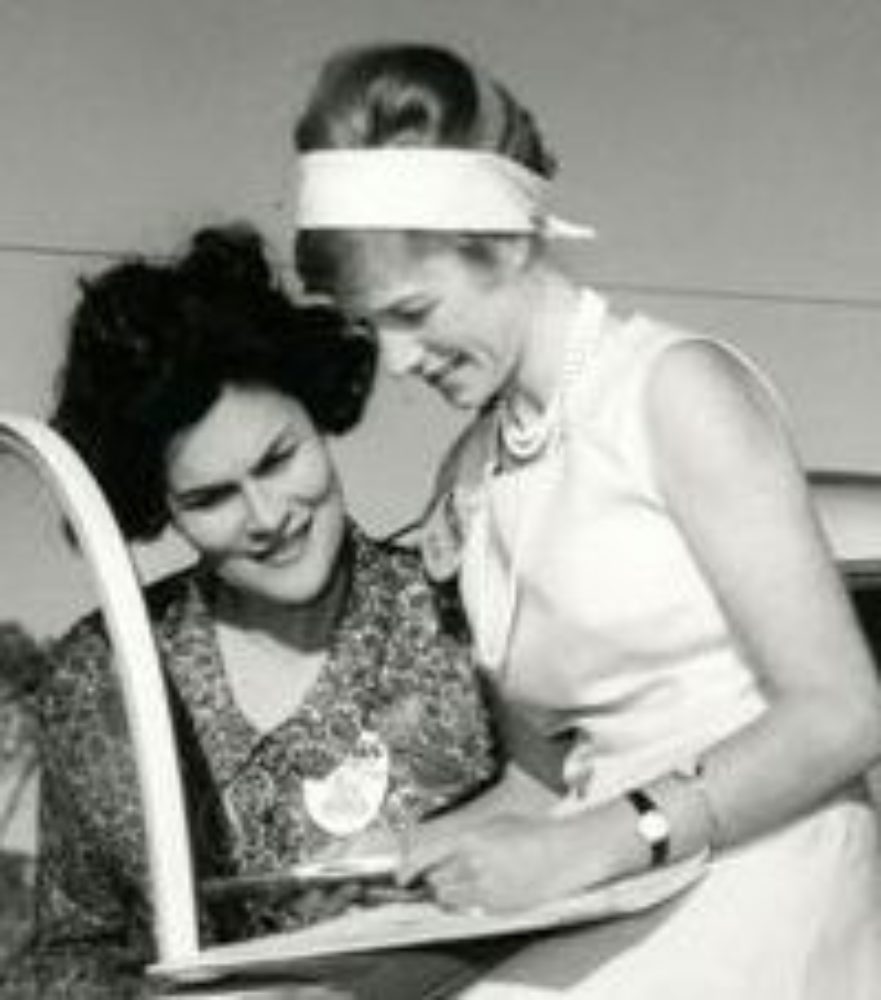
Once my children went away to school, it became almost TOO lonely and was really saved by flying. I’d been looking for an interest and I was just so in love with the feeling of freedom that one gets when one leaves the earth, that I just thought I simply must learn to fly. So, I did.
I was 34 when I started lessons and I had quite a lot of opposition from my side of the family, who really thought I’d taken leave of my senses (laughs).
Initially I took lessons at Perth Airport, but they were very spasmodic by the nature of the fact that I had to get to Perth. Then Cunderdin opened a flying school and I got my restricted licence there. While the academic side of the course (by correspondence) was a great burden – meteorology, navigation, theory of flight, engines and one other I forget – I was egged on by the sheer delight of being up there.
I was euphoric when I got my wings. The first experience of going solo is something VERY special, I think any pilot will tell you that. My first sol flight was at Perth Airport. There was a man in the control tower whose name was Kevin Beetson, and when I landed safely (thank heavens) he said “Congratulations. You’ve soloed.”
I said: “Yes. But I’m a WOMAN! I am a WOMAN!” (Well, of course, it may sound absurd to you, but in those days it was unusual for women to fly aeroplanes.) And he said “Yes, I know and it’s great!” It was all tape recorded in the tower, and he cut the piece out of the tape and gave it to me (chuckle).
My daughters loved flying with me; my son not so much and Stan said he preferred to keep his feet on the ground. I used to fly my elder daughter back and forth to school. The younger one would always say as we were roaring down the runaway: “Faster, Mum. Faster, Faster!” (laughs).
That was until she witnessed a fatal aircraft accident at Northam which had a very profound effect on her. She developed a total phobia about flying after that. It was most unfortunate.
In 1965, Stan and I decided to would try to establish a flying school at Wyalkatchem. In the beginning my husband and I were pretty well the whole box and dice. We purchased a Victa Air Tourer, which was the only Australian-made light aircraft at that time.
The Flying Club was a real feather in our cap because we were the first country flying club in Western Australia, other than a branch of the Royal Aero Club. We were successful in getting the services of Peter Dawe-Smith, who was an ex-Pakistani air force instructor. He was brilliant and students paid about $14 per hour for flying training.
We also managed to get the shire council to provide a little club house for us, which was a building that already existed in town. With great difficulty we managed to haul into onto a jinker (a low-loader) and transport it out to the aerodrome. I remember the locals sitting on the roof of the building as it was transported out there, and getting an extremely good view of things, as they slowly careered down the road. Much hilarity was had by all, wondering whether we’d ever get it there in one piece (chuckles).
The good offices of the shire council also came to our aid with their graders to build the air strip (about a mile out of town). It also meant that the Flying Doctor could come in there at any time, which is always very nice to know.
There were regular barbecues out at the strip. I remember one occasion; Johnny O’Keefe, of all people, who was a well-known rock star, flew to Wyalkatchem for the day. He appeared there for lunch, and we were doling out the sausages and one of my friends was behind the counter asked “Would you like beef or pork, Johnny?” And he said “Oh, you got pork sausages. Gas, man, Gas!” which caused a lot of mirth (hilarity)for some reason or other (laughs). Everything was “gas” in those days.
We had many happy times at our little aero club. It existed for eight years, and then we really seemed to exhaust the number of young, would-be pilots.
It was a tremendous wrench leaving Wyalkatchem after 40 years. I suppose it was simply out of necessity. One finds one’s life
changes, and you just have to bow to that. Our son and his family moved into the big house built by their grandfather.
I hope my family will have a very happy future in Wyalkatchem and in case they are reading this one day, there are a couple of things I’d love to say to them…
One is, keep a robust mind in life. Don’t forget, kindness in another’s troubles, and courage in one’s own. Look back and smile at perils past. And WHATEVER you do, put romance and enthusiasm into the life of your children. You know, it costs so much to be a full human being. There are few who have the love and the courage to pay the price, and one has to reach out to the risk of living with both arms.
As Morris West says: “One has to embrace life like a lover.”
Missed PART ONE read it here https://bit.ly/3ti2E7M
[Interview with Rosemary Mina de Pierres] [sound recording] / [interviewed by Betty Dagnia].
de Pierres, Rosemary Mina.
Oral History | 1992.
Available at 2nd Floor Oral History Stack (Call number: OH2458 Transcript (Access)
 The Flying Vicomtesse